


 PLATFORM UPDATE:

Planar inverted cone antenna based on silver nanowire network with enhanced interfacial adhesion after surface functionalization using (3-glycidyloxypropyl)trimethoxysilane
 *a
Andrew N.
Rider
a
*a
Andrew N.
Rider
a
Abstract
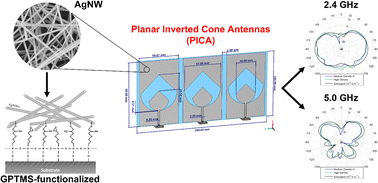
Silver nanowire (AgNW) has gained significant attention as a transparent conductive electrode over the past decade. However, the use of these unique one-dimensional nanostructures in antenna research is limited to only a few isolated studies. The design and fabrication of planar inverted cone antennas (PICA) based on transparent AgNW coatings is reported, covering both 2.4 GHz and 5.0 GHz Wi-Fi microwave bands. AgNW with high aspect ratio up to 680 (length and diameter of 58 µm and 85 nm, respectively) is synthesized through an optimized polyol process for this antenna fabrication. In addition, the well-known poor interfacial adhesion of AgNW is also addressed in this study using a simple one-step surface modification procedure with the aid of (3-glycidyloxypropyl)-trimethoxysilane (GPTMS). GPTMS-functionalized AgNW films at three different levels of transmittance are characterized in a PICA configuration. The measured bulk radio-frequency conductivity of σ = 4.4 × 10⁵ S m−1 together with the realized gain of the PICA at both 2.4 GHz and 5.0 GHz frequencies, demonstrates strong potential for the AgNW coating for Wi-Fi applications.
 Please wait while we load your content...


