


 PLATFORM UPDATE:

Promising magnetocaloric performance of nanostructured GdFeSi intermetallic ribbons for efficient natural gas liquefaction purposes
 ab
J. L. Sánchez
Llamazares,
c
L. G.
Escobedo-Valadez,
c
J. S.
Garitaonandia,
de
Pedro
Gorria,
*ab
Jesús A.
Blanco
a
and
J.
López-García
ab
ab
J. L. Sánchez
Llamazares,
c
L. G.
Escobedo-Valadez,
c
J. S.
Garitaonandia,
de
Pedro
Gorria,
*ab
Jesús A.
Blanco
a
and
J.
López-García
ab
Abstract
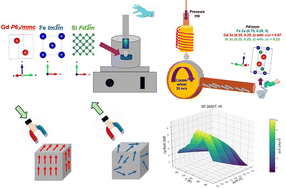
Some members of the RFeSi (R = Pr, Tb, Dy, Gd) family of intermetallic compounds, with tetragonal CeFeSi-type crystalline structure, exhibit low-temperature ferromagnetic behaviour. These alloys are of particular interest for two main reasons: (i) the Fe atoms appear to carry negligible or no magnetic moment, with R being solely responsible for the spontaneous magnetization; and (ii) they display a noticeable magnetocaloric effect (MCE) below 150 K. We have successfully fabricated single-phase GdFeSi ribbons in a one-step melt-spinning process, avoiding conventional thermal treatments such as long-time (several weeks) high-temperature annealing (above 1000 °C), thereby considerably reducing production costs. The ribbons show a broad entropy change leading to a relative cooling power of 517 J kg−1 (∼3.76 J cm−3) over 110–180 K, providing a useful working range despite a modest isothermal magnetic entropy peak value. Materials operating efficiently in this temperature window are relatively scarce compared with other intermetallic magnetocalorics. The magnetocaloric properties of GdFeSi ribbons, as shown by these results, make them promising for magnetic refrigeration technologies, including liquefaction processes for light hydrocarbons and industrial gases.
- This article is part of the themed collection: Celebrating International Women’s Day 2026: Women in Journal of Materials Chemistry C
 Please wait while we load your content...


