


Mn2O3–Co3O4 nanocomposites as advanced electrode materials: achieving high specific capacitance and excellent cycling stability
 *a
*a
Abstract
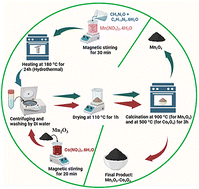
Mn2O3 particles were synthesized via a hydrothermal process and subsequently coated with Co3O4 to develop Mn2O3–Co3O4 composite particles as a supercapacitor electrode material. X-ray diffraction (XRD) confirms that the samples are crystallized and contain both Mn2O3 and Co3O4 phases. Mn2O3–Co3O4 nanoparticles with 40 min of reaction time displayed the highest specific surface area of 15.67 m2 g−1. The electrochemical behavior of Mn2O3–Co3O4 electrodes was investigated using charge/discharge measurements, cyclic voltammetry (CV), and electrochemical impedance spectroscopy (EIS) in a 1 M KOH electrolyte at room temperature. The specific capacitance (CSP) of Mn2O3–Co3O4-40 min exhibits an excellent value of 1289.6 F g−1 (an 81.8% increase compared to the uncoated Mn2O3). In addition, the corresponding nanoparticles give the highest energy density of 35.3 Wh kg−1 at a power density of 394.5 W kg−1. Mn2O3–Co3O4 electrodes show good specific capacitance retention of above 95% after 5000 cycles of continuous charge/discharge. The Co3O4 coating on Mn2O3 not only enhances electrical conductivity but also introduces multiple redox couples (Mn2+/Mn3+, Mn3+/Mn4+, and Co2+/Co3+), enabling rapid and reversible redox reactions. This synergistic effect significantly enhances charge transfer kinetics and overall electrochemical performance, indicating that the Mn2O3–Co3O4 nanoparticle is a highly promising electrode material for next-generation supercapacitors.
 Please wait while we load your content...


