


Cs2AgBiBr6@TiO2 nanocomposites with enhanced nonlinear absorption and electrochemical properties
 *ab
*ab
Abstract
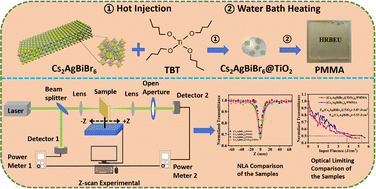
To solve the toxicity and stability issues of traditional lead halide perovskites, Cs2AgBiBr6@TiO2 nanocomposites were synthesized via a thermal injection method. Cs2AgBiBr6 quantum dots (QDs) and Cs2AgBiBr6@TiO2 nanocomposites were dispersed in methyl methacrylate (MMA) to prepare (Cs2AgBiBr6)6/PMMA and (Cs2AgBiBr6@TiO2)6/PMMA organic glasses (OGs). The nonlinear absorption (NLA) properties of the materials were investigated using the open-aperture Z-scan technique, revealing that after compositing with TiO2, the reverse saturable absorption (RSA) coefficient of the (Cs2AgBiBr6@TiO2)6/PMMA OG increased from 194 cm GW−1 to 294 cm GW−1 at an energy of 10 µJ. This is attributed to the incorporation of TiO2, which facilitates interfacial charge separation and accelerates electron transfer, thereby significantly enhancing the RSA of Cs2AgBiBr6@TiO2. Under identical testing conditions, the optical limiting thresholds of the (Cs2AgBiBr6)6/PMMA and the (Cs2AgBiBr6@TiO2)6/PMMA OGs were measured to be 5.33 J cm−2 and 3.87 J cm−2, respectively. Compared to the (Cs2AgBiBr6)6/PMMA OG, the (Cs2AgBiBr6@TiO2)6/PMMA OG demonstrates superior optical limiting performance. Electrochemical impedance spectroscopy (EIS) measurements demonstrated that Cs2AgBiBr6@TiO2 exhibits lower impedance (Rct) and favorable photocurrent response (0.61 µA cm−2), confirming its efficient charge separation/transport capability, which further promotes the RSA effect of Cs2AgBiBr6@TiO2. These results indicate that Cs2AgBiBr6@TiO2 holds promising potential for applications in optical limiting devices.
 Please wait while we load your content...


