


 PLATFORM UPDATE:


Aggregation-induced emission-active thermally activated delayed fluorescent materials for solution-processed organic light-emitting diodes: a review
 *a
*a
Abstract
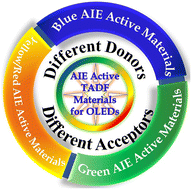
Thermally activated delayed fluorescence (TADF) materials with aggregation-induced emission (AIE) properties have attracted great attention recently. Specifically, multiple-resonance TADF (MR-TADF) emitters are of particular interest as next-generation narrowband luminophores for organic light-emitting diodes (OLEDs) due to their intrinsically narrow emission bands, high photoluminescence efficiencies, and facilely tunable emission colors. The incorporation of AIE behavior into TADF or MR-TADF platforms has been a successful approach towards maximizing exciton utilization in the solid state. In contrast to traditional planar luminophores plagued by aggregation-caused quenching (ACQ), AIE-active emitters are characterized by emission enhancement upon aggregation, enabling the realization of OLEDs with high external quantum efficiencies and low efficiency roll-off. In this review, we present recent progress in AIE-active traditional TADF emitters that are classified based on their emission color (blue, green, and yellow/red) with a focus on non-doped OLED device structures. Additionally, AIE-active MR-TADF materials are presented and compared with their traditional TADF counterparts. Part of the special emphasis is placed on molecular design tenets, structure–property correlations, photophysical phenomena, and device performance optimization. This review tries to give insights into rational molecular design strategies for the construction of next-generation AIE-active TADF and MR-TADF emitters for high-performance OLED applications.
- This article is part of the themed collection: Journal of Materials Chemistry C Recent Review Articles
 Please wait while we load your content...


