Bypassing sulfides: comparing the morphology and performance of solution processed Cu(In,Ga)Se2 films prepared via two selenide molecular precursor routes

Abstract

Solution-processing of thin-film photovoltaics offers an alternative to vacuum-deposition based approaches. The amine–thiol reactive solvent system has become a focal point for the solution-processing of chalcogenide species, owing to the convenience of precursor preparation and comparatively high performance of prepared devices. Selenide species prepared via the amine–thiol route typically progress through a sulfide intermediate phase, and as such are commonly afflicted with sulfur and carbon impurities along- side the presence of a carbonaceous fine-grained layer. Here, two routes of preparing films directly to a selenide phase are examined; first by the co-dissolution of selenium in an amine–thiol solution and second via the novel use of reactive alkylammonium polyselenides. Lamella are cut from these selenide precursor films and final devices, and STEM-EDX and TEM are used to characterize film morphology and secondary phases. A champion device efficiency of 11.2% is reported for the novel polyselenide route, and clear paths of improvement are identified.
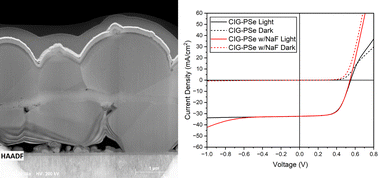
Graphical abstract: Bypassing sulfides: comparing the morphology and performance of solution processed Cu(In,Ga)Se2 films prepared via two selenide molecular precursor routes

Supplementary files

Transparent peer review

To support increased transparency, we offer authors the option to publish the peer review history alongside their article.

View this article’s peer review history

Article information

Article type
Paper
Submitted
24 Jun 2025
Accepted
12 Nov 2025
First published
24 Nov 2025
This article is Open Access
Creative Commons BY-NC license

J. Mater. Chem. C, 2026, Advance Article

Bypassing sulfides: comparing the morphology and performance of solution processed Cu(In,Ga)Se2 films prepared via two selenide molecular precursor routes

R. Spilker, D. C. Hayes, S. Agarwal, K. Kisslinger and R. Agrawal, J. Mater. Chem. C, 2026, Advance Article , DOI: 10.1039/D5TC02433A

This article is licensed under a Creative Commons Attribution-NonCommercial 3.0 Unported Licence. You can use material from this article in other publications, without requesting further permission from the RSC, provided that the correct acknowledgement is given and it is not used for commercial purposes.

To request permission to reproduce material from this article in a commercial publication, please go to the Copyright Clearance Center request page.

If you are an author contributing to an RSC publication, you do not need to request permission provided correct acknowledgement is given.

If you are the author of this article, you do not need to request permission to reproduce figures and diagrams provided correct acknowledgement is given. If you want to reproduce the whole article in a third-party commercial publication (excluding your thesis/dissertation for which permission is not required) please go to the Copyright Clearance Center request page.

Read more about how to correctly acknowledge RSC content.

Social activity

Spotlight

Advertisements