


Intermolecular charge-transfer phosphorescence in organometallic–organic doped crystals dominated by the iridium complex lattice

Abstract
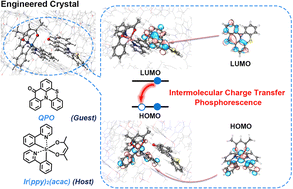
Charge-transfer transitions constitute a pivotal mechanism for modulating the photophysical characteristics in organic luminescent materials. Intermolecular charge transfer transitions offer flexibility for designing organic light-emitting materials beyond the single-molecule level. However, the lower-lying triplet excited states in such systems usually remain in the dark state and decay either through reverse intersystem crossing, triplet–triplet energy transfer or nonradiative transitions. Activating the emission from the lowest triplet intermolecular charge-transfer excited states unlocks new possibilities for advancing organic optoelectronics. In this study, we demonstrate a crystal engineering strategy by incorporating a multi-resonance organic molecule, 9H-quinolino[3,2,1-kl]phenothiazin-9-one (QPO), into a crystal matrix of a phosphorescent iridium complex, bis(2-phenylpyridine)(acetylacetonate)iridium (Ir(ppy)2(acac)). The crystalline lattice enables tighter binding between QPO and Ir(ppy)2(acac) molecules, facilitating strong intermolecular charge transfer interactions. The doped crystal exhibits a remarkable 135 nm bathochromic shift in emission compared to its individual components and amorphous counterpart. Through detailed experimental and theoretical characterization of the crystal, we attributed the emission to phosphorescence from the lowest intermolecular charge-transfer state with a triplet character. The proposed crystal design approach can be applied to a broad class of materials, opening new opportunities for improving the performance of optoelectronic devices.
 Please wait while we load your content...


