


 PLATFORM UPDATE:


Microfluidic preparation of programmable porous conductive hydrogel microfibers for wide-range and sensitive physiological monitoring

Abstract
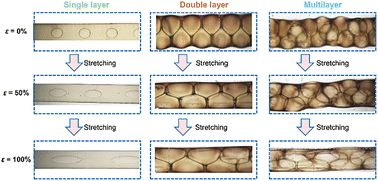
Conductive hydrogel microfibers (CHMFs), renowned for their flexibility and knittability, have emerged as promising candidates for wearable strain sensors in health monitoring and human–machine interaction. To accurately capture diverse physiological signals, CHMFs must simultaneously achieve high sensitivity, broad sensing range, and reliable mechanical compliance. Herein, we present a microfluidic spinning strategy that enables the synergistic integration of tailored material-component design and programmable bubble-based structural control to fabricate porous hydrogel microfibers (PM-CHMFs) with excellent sensing performances. Surfactant-assisted surface modification of multi-walled carbon nanotubes (MWCNTs) enhances their dispersion within the polymer matrix, thus yielding a homogeneous percolative network to improve electrical conduction and enhance mechanical strength. Meanwhile, hierarchical porous configurations of microfibers that can deliberately induce stress concentration and amplify local strain are achieved through microfluidic programming of microbubble arrangements. Benefiting from the rational design of both fiber components and structures, the resultant PM-CHMFs demonstrate an extensive sensing range (0.025–250%), a high gauge factor (up to 4.006), a rapid response time (∼540 ms), excellent cycling stability (5000 cycles) and environmental tolerance. Our findings not only offer a novel strategy to prepare porous conductive hydrogel microfibers with enhanced sensitivity and stretchability but also establish a versatile and scalable platform for engineering advanced fiber-based sensors suited for monitoring diverse physiological signals.
 Please wait while we load your content...


