


 PLATFORM UPDATE:


Substrate-directed zinc phosphate nanodeposition for durable dentin bonding: one-step interfacial dehydration and proteolysis resistance

Abstract
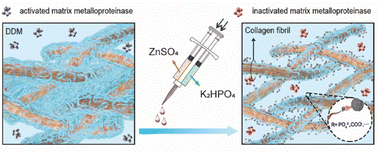
Achieving durable bonding at hydrated polymer–collagen biointerfaces remains challenging because water trapped at the interface and matrix metalloproteinase (MMP)-driven collagen degradation undermine adhesion over time. Using dentin as a clinically relevant collagen scaffold, we introduce a single-step, substrate-directed pretreatment that rapidly drives in situ nanodeposition of zinc phosphate nanoparticles (nano-ZnPs) along collagen fibrils. This approach simultaneously modulates interfacial hydration, adhesive infiltration, and proteolytic activity. A kinetically unstable ZnSO4/K2HPO4 precursor was applied to demineralized dentin to promote site-selective capture, nucleation, and fibril-conformal growth of nano-ZnPs. Interfacial hydration and adhesive infiltration were quantified, gelatinolytic activity was characterized under exogenous and endogenous challenges, and bonding performance was evaluated using microtensile bond strength (µTBS) and nanoleakage, with durability assessed after 10 000 thermal cycles. Cytocompatibility was also examined. Nano-ZnPs preferentially deposited within polar/anionic collagen domains as amorphous 5–20 nm particles, reduced interface-confined water, and facilitated deeper infiltration of hydrophobic monomers, while a zinc-enriched interface exhibited markedly attenuated proteolytic activity under both exogenous and endogenous challenges. Compared with controls, a 30 s pretreatment increased µTBS by 21–32% and reduced nanoleakage by 66–78%. Interfacial integrity was maintained after thermal aging, and no detectable cytotoxicity was observed. These results establish kinetically programmed, collagen-guided nanodeposition as a workflow-compatible strategy for strengthening resin–dentin interfaces without altering adhesive formulations or curing protocols.
- This article is part of the themed collection: Journal of Materials Chemistry B HOT Papers
 Please wait while we load your content...


