


 PLATFORM UPDATE:


Peptide dendritic polymerization-enabled stable and tailorable nanoparticles as crosslinkers for fabricating multifunctional hydrogels with enhanced wound healing efficacy
 *a
*a
Abstract
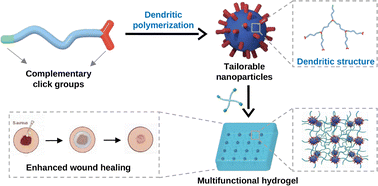
Developing biomedical nanomaterials that seamlessly integrate structural stability, precise modifiability, and inherent biocompatibility remains a significant challenge. Peptides are ideal candidate building blocks for constructing biocompatible nanomaterials. However, traditional peptide assembly often relies on weak non-covalent interactions, limiting their stability and functional diversity. Drawing on dendrimer design principles, we design peptide monomers capable of undergoing covalent dendritic polymerization via efficient click chemistry to generate peptide nanoparticles. These nanoparticles exhibit high stability independent of peptide sequence, coupled with a facilely modifiable surface that renders them versatile building blocks for the fabrication of advanced functional materials. Subsequently, we employed cationic peptide-based nanoparticles as multifunctional crosslinkers within a polyethylene glycol (PEG) network to fabricate a hybrid hydrogel tailored for infected wound management. The resulting hydrogel exhibited excellent mechanical stability, resistance to swelling, and inherent antibacterial activity. In a full-thickness infected wound model, the hydrogel markedly accelerated wound healing by effectively eradicating bacteria, attenuating inflammation, and promoting angiogenesis. This work not only introduces a high-performance therapeutic dressing but also establishes a peptide-based dendritic polymerization strategy as a generalizable platform for the rational design of precise, multifunctional biomaterials.
 Please wait while we load your content...


