


 PLATFORM UPDATE:


Enzyme-responsive targeted nanomedicines: a novel strategy for cancer therapy
 b
b
Abstract
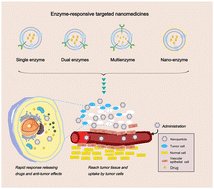
Enzyme-responsive targeted nanomedicines have emerged as a promising approach for precision cancer therapy, capitalizing on the unique biochemical features of the tumor microenvironment (TME) to achieve localized and controlled drug release. Tumor tissues often overexpress or selectively activate enzymes such as proteases, glycosidases, and lipases, which can be utilized to trigger the release of therapeutic agents from nanocarriers. This strategy enhances the therapeutic efficacy of anticancer drugs while minimizing systemic off-target toxicity. Recent advances have expanded from single-enzyme systems to more sophisticated dual- and multi-enzyme responsive platforms, improving drug release kinetics and targeting specificity. Additionally, innovations in nanocarrier design, including surface functionalization and improved biocompatibility, have addressed key limitations. Another key advancement involves embedding nanozymes (nanomaterials possessing enzyme-mimetic activities) within nanomedicines. This integration enables catalytic enhancement of nanocarrier degradation and prodrug activation at tumor sites. Nevertheless, persistent challenges regarding nanocarrier stability, targeting efficiency, and tumor microenvironment complexity demand resolution. This review provides an overview of current developments, highlighting the mechanisms, therapeutic potential, and future directions for enzyme-responsive nanomedicines in cancer treatment.
- This article is part of the themed collection: Journal of Materials Chemistry B Recent Review Articles
 Please wait while we load your content...


