Influence of liquid repellency and slipperiness on blood-material interactions

Abstract

Blood-contacting medical devices are an integral part of modern medicine, but as a foreign material, the immune system is inherently activated and induces thrombosis. To avoid the adverse effects of the devices, concurrent anticoagulant therapies are frequently administered, but anticoagulants carry their own detrimental risks. Therefore, we investigated the interactions of blood cells with non-textured surfaces on glass coverslips functionalized with polymeric brushes. We synthesized four categories of distinct surface coatings and characterized them based on liquid repellency and slipperiness: less slippery hydrophobic, more slippery hydrophobic, less slippery hydrophilic, and more slippery hydrophilic. Fluorescent imaging revealed that platelets and leukocytes adhere and activate significantly less on the more slippery hydrophilic (SLIC) surfaces compared to the other three surfaces. Microfluidics coupled with fluorescent microscopy showed that under dynamic conditions with an actively polymerizing flow buffer, the SLIC-coated glass not only inhibited clot growth, but also enabled clot degradation compared to uncoated glass. This work demonstrates the potential of SLIC surfaces in reducing adverse thrombotic events resulting from blood-contacting medical devices.
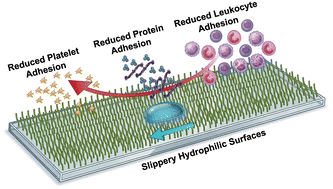
Graphical abstract: Influence of liquid repellency and slipperiness on blood-material interactions

Supplementary files

Article information

Article type
Communication
Submitted
05 Dec 2025
Accepted
07 Apr 2026
First published
20 Apr 2026
This article is Open Access
Creative Commons BY-NC license

J. Mater. Chem. B, 2026, Advance Article

Influence of liquid repellency and slipperiness on blood-material interactions

H. J. Cantor, A. Rather, R. Rajasekaran, A. Aligwekwe, A. C. Brown and A. K. Kota, J. Mater. Chem. B, 2026, Advance Article , DOI: 10.1039/D5TB02723C

This article is licensed under a Creative Commons Attribution-NonCommercial 3.0 Unported Licence. You can use material from this article in other publications, without requesting further permission from the RSC, provided that the correct acknowledgement is given and it is not used for commercial purposes.

To request permission to reproduce material from this article in a commercial publication, please go to the Copyright Clearance Center request page.

If you are an author contributing to an RSC publication, you do not need to request permission provided correct acknowledgement is given.

If you are the author of this article, you do not need to request permission to reproduce figures and diagrams provided correct acknowledgement is given. If you want to reproduce the whole article in a third-party commercial publication (excluding your thesis/dissertation for which permission is not required) please go to the Copyright Clearance Center request page.

Read more about how to correctly acknowledge RSC content.

Social activity

Spotlight

Advertisements