


 PLATFORM UPDATE:


Multifunctional stealth chitosan nanogels with improved relaxivity and photoacoustic contrast for dual MRI–MSOT imaging

Abstract
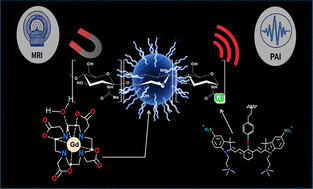
The development of imaging probes capable of addressing both resolution and sensitivity remains a major challenge in diagnostic imaging, as no single modality can meet these requirements alone. Here, we introduce a stealth bimodal imaging platform based on chitosan/tripolyphosphate nanogels (CS/TPP nanogels) engineered to combine magnetic resonance imaging (MRI) and photoacoustic imaging (PAI) capabilities. The nanogels are formed through ionic gelation and incorporate GdDOTA chelates for MRI contrast enhancement together with ZW800, a near-infrared absorber covalently grafted onto chitosan (CS-ZW800), to enable photoacoustic detection. The addition of pegylated chitosan (CS-PEG2000) confers stealth behavior and stabilizes the nanosuspensions. A systematic study of the influence of the CS-PEG2000 degree of substitution enabled the optimization of (CS-PEG2000)/TPP nanogel formation, followed by the preparation of (CS-PEG2000/CS-ZW800)/TPP nanogels and their final loading with GdDOTA. NMRD curves demonstrated a markedly enhanced longitudinal relaxivity at 1.5 T - approximately six times higher than free GdDOTA - and confirmed efficient MRI contrast at 3 T. In parallel, photoacoustic spectral measurements revealed that GdDOTA-loaded nanogels generated a significantly stronger PAI signal than ZW800 alone, as well as a higher signal intensity than gadolinium-free (CS-PEG2000/CS-ZW800)/TPP nanogels. Together, these findings show that encapsulating GdDOTA within CS-PEG2000/CS-ZW800 nanogels not only improves MRI efficiency but also enhances PAI performance. This work highlights a simple route to multifunctional nanogels capable of synergistically boosting both magnetic and acoustic contrast.
 Please wait while we load your content...


