


 PLATFORM UPDATE:


The chemical design of antimicrobial ionic liquids guided by machine learning: a review on balancing efficacy and toxicity
 *ab
Yuqing
Miao
*a
*ab
Yuqing
Miao
*a
Abstract
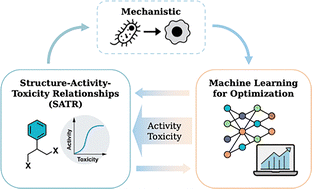
The design of new antimicrobial materials is a critical challenge in chemistry and materials science, driven by the global threat of multidrug-resistant pathogens. Ionic liquids (ILs) represent a highly versatile class of materials, where their chemical structure can be systematically designed to achieve desired functions. However, a significant hurdle in their application as antimicrobial agents is the inherent trade-off between antibacterial efficacy and host toxicity. This review addresses this materials design challenge by focusing on the use of machine learning (ML) to guide the chemical design of ILs. We provide a comprehensive overview of the chemical mechanisms that drive both the desired antimicrobial activity and the undesired toxicity. We then detail how an understanding of these structure–property relationships is being leveraged to build predictive quantitative structure–toxicity relationship (QSTR) models. A central focus is the application of ML for multi-objective optimization, which allows for the rational design and virtual screening of ILs with optimal efficacy–toxicity profiles. By connecting the design of cationic and anionic structures to biological outcomes, this review offers a forward-looking perspective on the data-driven chemical design of the next generation of antimicrobial materials, highlighting the synergy between materials chemistry and computational science.
- This article is part of the themed collections: Journal of Materials Chemistry B HOT Papers and Journal of Materials Chemistry B Recent Review Articles
 Please wait while we load your content...


