


 PLATFORM UPDATE:


High-performance uric acid detection using a hierarchical NiO nanostructure-based biosensor

Abstract
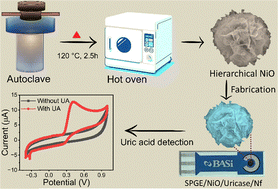
Nanomaterials engineering combined with enzyme conjugation is driving advances in biosensing. In this study, an electrochemical biosensor based on a hierarchical NiO nanostructure and uricase was developed to achieve high sensitivity and selectivity for uric acid (UA) detection. The hierarchical NiO nanostructure material was synthesized via a hydrothermal method and characterized in detail. The UA biosensor was constructed using a hierarchical NiO nanostructure fixed onto the screen-printed graphite electrode (SPGE), with physically adsorbed uricase on the nanomaterial surface, and Nafion (Nf). The electrochemical characteristics of the SPGE/NiO/uricase/Nf biosensor were studied using the cyclic voltammetry (CV) technique. CV analysis revealed that the fabricated SPGE/NiO/uricase/Nf biosensor responded rapidly to UA over a wide concentration range of 25–900 µM, exhibiting a high sensitivity of 423.5 ± 2.6 µA mM−1 cm−2 and a detection limit of ∼1.45 ± 0.12 µM. The biosensor successfully detected UA in human serum and artificial saliva samples. It also demonstrated excellent reproducibility (RSD of < 6.5%), reusability (retaining ∼90.4% of its initial current response for up to 18 days), and strong anti-interference capability. This enhanced performance resulted from the synergistic electrochemical properties of the hierarchical NiO nanostructure and the uricase enzyme, in which NiO facilitates electron transfer and uricase enhances selective electrocatalytic activity towards UA. These results support its potential for clinical diagnostic use.
 Please wait while we load your content...


