


 PLATFORM UPDATE:


Biocompatible thermal shape-memory poly(lactide-co-trimethylene carbonate) elastomers for cell culture scaffold application

Abstract
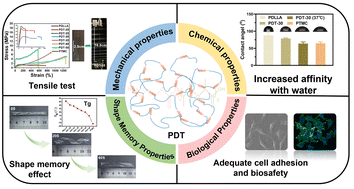
Biocompatible shape-memory polymers are promising next-generation tissue engineering biomaterials that possess low toxicity, tunable mechanical strength, and programmable movement and actuation properties. To develop low cost, biocompatible and controllable shape-memory polymers, in this work, we prepared Poly(lactide-co-trimethylene carbonate) copolymers (PDTs) by incorporating flexible trimethylene carbonate (TMC) segments into the rigid poly(DL-lactide) (PDLLA) backbone via ring-opening copolymerization. The polymerization conditions were optimized through a systematic orthogonal experimental design. Compared with brittle PDLLA (initial elongation at break: ∼7%), the introduction of TMCs resulted in a significant improvement in the flexibility and ductility (elongation at break for PDT: 27.6–1288%). The thermal shape-memory/recovery rate of PDTs after cyclic deformation is more than 95%, the adjustable thermomechanical properties (Tg: 41.54–10.14 °C) enable their programmable thermal shape-memory function. Moreover, the introduction of TMCs could alleviate local acid degradation of PDLLA, improve the hydrophilicity (water contact angle reduced from 97.75° to 62.25°), and maintain excellent cytocompatibility (meet the medical grade standard). The results showed that PDT copolymers possess tunable elasticity, acid degradation resistance, and enhanced bioactivity, making them promising biocompatible thermal shape-memory elastomers for cell culture scaffold application towards tissue engineering.
 Please wait while we load your content...


