


 PLATFORM UPDATE:


Water status of photocurable decellularised extracellular matrix hydrogels using DSC and NMR relaxometry

Abstract
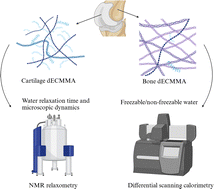
The development and characterisation of decellularised tissues have become a focus in biomaterial sciences and tissue engineering. In the extracellular matrix (ECM) of tissues, water acts as a structural and biochemical mediator, maintaining hydration, enabling molecular transport, contributing to the regulation of mechanical properties, and facilitating biochemical reactions. However, the dynamics and behaviour of water inside hydrogel biomaterials are scarcely discussed, likely due to the limited availability of observation methods and models. In this study, differential scanning calorimetry (DSC) was applied to study the status of water in photocurable decellularised extracellular matrix (dECMMA) hydrogels; furthermore, 1H NMR time-domain nuclear magnetic resonance (TD-NMR) was combined with Solomon–Bloembergen–Morgan theory to determine the effective rotational correlation time of water in dECMMA. Additionally, the dynamics of bound water and bound-water fraction were calculated via an established two-site exchange model. The main finding is that the cartilage dECMMA showed a fast bound water tumbling rate. In contrast, lung dECMMA showed a high bound-water fraction compared with other dECMMA and gelatin methacrylate (GelMA) hydrogels. This work demonstrates how the convergence of DSC, NMR and theoretical modelling allows for the study of water status in hydrogels at the molecular level.
 Please wait while we load your content...


