


 PLATFORM UPDATE:


Turn-on near-infrared fluorescence/positron emission tomography dual-modal probe for intracranial hemorrhage diagnosis
 *bd
Richard
Ting
*d
and
*bd
Richard
Ting
*d
and
Abstract
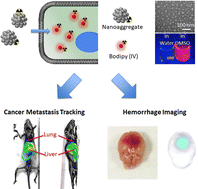
Live cell tracking is a critical technical requirement across regenerative medicine, disease mechanism research, immunotherapy, and diagnosis. Rapid, wash-free labeling with multimodal imaging capabilities would greatly facilitate subsequent in vivo applications. Herein, we report a general, wash-free, and rapid live cell labeling strategy using an 18F-radiolabeled near-infrared fluorescent Bodipy dye. In extracellular solution, the dye self-assembles into fluorescence-quenched 18F-positron emitting nanoparticles, while upon cellular endocytosis, the nanoparticles disassemble, triggering a >170-fold fluorescence “turn-on” that eliminates background interference without washing. The integration of fluorescence and positron emission tomography (PET) at the molecular level enables accurate in vivo cell tracking via whole-body PET scanning and local fluorescence imaging. We validated the strategy by labeling cancer cells for tracking tumor metastatic circulation and red blood cells for imaging intracranial hemorrhage (stroke), demonstrating its broad utility for in vivo cell-tracking applications.
- This article is part of the themed collection: Journal of Materials Chemistry B HOT Papers
 Please wait while we load your content...


