


 PLATFORM UPDATE:


Toward continuous and non-invasive monitoring: a scoping review of in vitro blood glucose devices from electrochemistry to optics and micro-system integration

Abstract
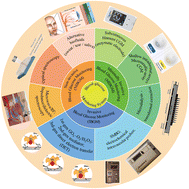
Abnormal blood glucose levels trigger acute symptoms and drive long-term complications across vascular, renal, neural, and ocular systems. Overall, this review traces the transition in blood glucose monitoring from fingerstick SMBG to continuous monitoring and to non-invasive routes and classifies technologies by invasiveness into IBGM, MIBGM, and NIBGM. Key evaluation metrics include MARD, time lag, wear time, and calibration burden, in particular for clinical translation. It outlines the evolution from reflectance photometry to enzyme amperometry in first- and second-generation sensors and to direct electron transfer in third-generation designs using nanomaterials. For MIBGM, it summarizes microneedle, subcutaneous, and microdialysis routes, outlining device architectures. Representative systems include Dexcom, Libre, Eversense, and shallow intradermal arrays such as Biolinq Shine. This review compiles non-invasive evidence across NIR and MIR, Raman, OCT, and microwave or impedance methods and also covers sweat, tear, and saliva approaches. Raman studies report a MARD of nearly 12–15% with most points in clinically acceptable error-grid zones, and microwave studies report a wide range of performances spanning from an ex vivo MARD of nearly 1.31% to wearables with about 99% of points in clinically acceptable error-grid zones. Additionally, from a system perspective, it highlights microfluidics, MEMS, flexible electronics, and nanomaterials for wearable integration and antifouling. Finally, it identifies accuracy limits for tissue optics or dielectric effects, individual variability, calibration, lag, drift, and lifetime, and calls for scenario-based stress testing and multi-center validation.
- This article is part of the themed collection: Journal of Materials Chemistry B Recent Review Articles
 Please wait while we load your content...


