


 PLATFORM UPDATE:


MSC-derived osteogenic cell sheets on stiffness-tuned hyaluronic acid–gelatin hydrogels
 *a
*a
Abstract
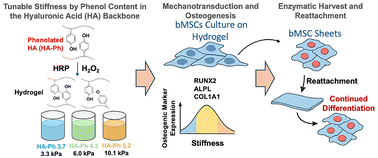
Osteogenic cell sheets retain intercellular junctions and their native extracellular matrix, enabling stage-specific support for bone repair. To engineer such sheets under controlled mechanical cues, we developed stiffness-tuned composite hydrogels via enzymatic crosslinking of phenolated hyaluronic acid (HA-Ph) and gelatin (Gelatin-Ph) using horseradish peroxidase and hydrogen peroxide (H2O2). We evaluated the ability of these hydrogels to support osteogenic differentiation and enable cell sheet fabrication from human bone marrow-derived mesenchymal stem cells (bMSCs). Hydrogel stiffness was controlled by varying the degree of phenolation in HA-Ph (3.7, 4.3, and 5.2 phenol groups per 100 repeating units) at a fixed polymer concentration, resulting in hydrogels with Young's moduli of 3.3, 6.0, and 10.1 kPa, respectively. The stiffest hydrogel (10.1 kPa) enhanced YAP nuclear localisation in bMSCs, whereas the hydrogel with intermediate stiffness (6.0 kPa) most effectively induced osteogenic differentiation, as evidenced by the high expression levels of osteogenic marker genes, including ALP1, COL1A1, and RUNX2. By day 7, cells on the hydrogels had already initiated differentiation, enabling the detachment of cell sheets containing partially differentiated bMSCs, which were subsequently re-adhered to a new surface without losing their osteogenic potential. These findings demonstrate the potential of stiffness-tuned HA-Ph/Gelatin-Ph composite hydrogels as effective platforms for bone tissue engineering using cell sheets.
 Please wait while we load your content...


