


 PLATFORM UPDATE:


High-sensitivity fluorescent immunochromatographic test strips for point-of-care testing of tenuazonic acid: hapten design, monoclonal antibody preparation, and assay development
 a
Hua
Kuang
a
a
Hua
Kuang
a
Abstract
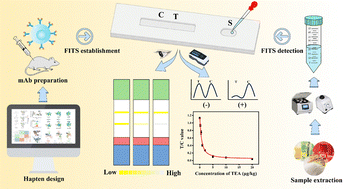
In recent years, tenuazonic acid (TEA) has been frequently detected in various types of food. TEA is acutely toxic, cytotoxic, carcinogenic, and genotoxic, thus posing a threat to public health. Therefore, there is an urgent need to develop more efficient and convenient methods to meet the demand for rapid detection of TEA. In the present study, we designed and optimized a hapten by analyzing the spatial conformation, similarity, surface electrostatic potential, pharmacophores, and atomic charges, prepared a highly sensitive and specific anti-TEA monoclonal antibody (mAb), 4C12 (IC50 = 0.11 ng mL−1), and developed a fluorescence immunochromatographic test strip (FITS) for the detection of TEA in wheat flour, tomato paste, and apple juice samples with calculated limits of detection of 0.29, 0.88, and 0.11 µg kg−1, respectively. The accuracy of the FITS was verified by spiking recovery experiments and detection in real samples, realizing point-of-care testing of TEA in different food products.
 Please wait while we load your content...


