


Synergistically assembled inorganic–organic multifunctional injectable bone cement with enhanced mechanical properties and osteogenesis
 *a
*a
Abstract
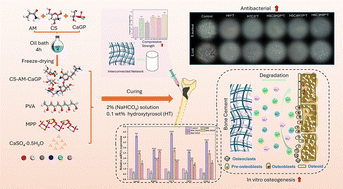
Calcium sulfate cement (CSC) is limited in clinical applications due to its low mechanical strength, rapid degradation, and insufficient bioactivity. Here, we developed a novel composite bone cement by integrating acrylamide-grafted chitosan (CS–AM) with calcium glycerophosphate (CaGP) and incorporating magnesium polyphosphate (MPP) and polyvinyl alcohol (PVA) to enhance structural and functional properties. The composite was systematically evaluated using experimental characterization and Materials Studio molecular simulations to elucidate intermolecular interactions. Molecular simulations revealed strong interactions between CS–AM and CaGP, as well as between MPP and PVA, forming a dense hydrogen-bond network. Electrostatic potential and electron density analyses confirmed stable interfacial bonding and structural integrity. The test results of compressive strength, injectability and degradation profile demonstrated the combination of the components. Notably, the HCMP composite greatly enhanced osteogenic differentiation, with quantitative PCR showing substantial upregulation of Runx2, BMP2, OCN, OPN, and COL1 enhanced by 4.11-, 2.77-, 4.34-, 2.60-, and 3.57-fold, respectively, relative to controls. Hydroxytyrosol (HT) was further introduced to confer antibacterial activity. Collectively, these findings indicate that the engineered composite exhibits superior mechanical and biological performance and that molecular-level insights provide a rational foundation for the design of high-performance bone repair materials.
 Please wait while we load your content...


