


 PLATFORM UPDATE:


Electroconductive and highly biocompatible PEDOT- and polypyrrole-alginate–gelatin hydrogels with enhanced electrochemical performance for biointerfaces

Abstract
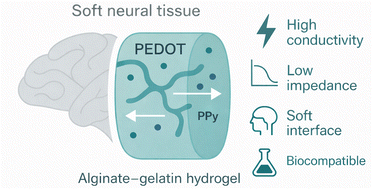
Conductive hydrogels are promising candidates for neural bioelectrodes due to their softness, ionic permeability, and reduced mechanical mismatch with neural tissue. However, pristine biopolymer matrices such as alginate–gelatin (Alg–GEL) lack sufficient electrical functionality. Here, Alg–GEL hydrogels incorporating PEDOT:PSS, polypyrrole (PPy/PSS), or both were developed via blending and in situ polymerization, yielding a tunable family of soft, electroactive materials. The hydrogels exhibited Young's moduli of 5–70 kPa, depending on polymer loading, while electrical conductivities ranged from 0.1 to 3.7 S cm−1, with the highest values observed in PEDOT–PPy hybrids. Electrochemical measurements showed impedance values of 380–830 Ω cm2 at 1 kHz, an electrochemical stability window of approximately −0.85 to +1.2 V vs. Ag/AgClsat, and current injection limits reaching 4 mA, comparable to platinum electrodes. Swelling studies indicated that PEDOT-modified hydrogels achieved 41–56% swelling after 24 hours. PPy-based hydrogels swelled to approximately 97% and hybrid systems showed behavior dependent on their composition. All conductive formulations demonstrated improved long-term stability compared to pristine Alg–GEL, which gradually lost mass over 28 days of incubation. In contrast, hydrogels containing PEDOT and PPy maintained nearly constant wet weight, consistent with the formation of interpenetrating networks that prevented polymer degradation and leaching. Biological evaluation with NIH3T3 fibroblasts showed that all hydrogels were cytocompatible. PPy-only and PPy–PEDOT hybrids supported higher metabolic activity and more attached and spread cells after 7 days compared to Alg–GEL, while PEDOT-only samples showed similar or slightly reduced cell activity. These results confirm excellent cytocompatibility and suggest that PPy-rich domains improve cell–material interactions. Overall, PEDOT- and PPy-modified Alg–GEL hydrogels offer high conductivity, softness, electrochemical stability, long-term durability, and biocompatibility, creating a versatile and adjustable platform for next-generation soft neural interfaces.
 Please wait while we load your content...


