


 PLATFORM UPDATE:


Non-cytotoxic, iodinated poly(ethylene oxide) (PEO) block-co-polymer contrast agents for computed tomography (CT) imaging
 a
Kendell M.
Pawelec,
cd
Netsanet
Waal,
a
D. Adam
Lauver
b
and
Robert C.
Ferrier, Jr.
*a
a
Kendell M.
Pawelec,
cd
Netsanet
Waal,
a
D. Adam
Lauver
b
and
Robert C.
Ferrier, Jr.
*a
Abstract
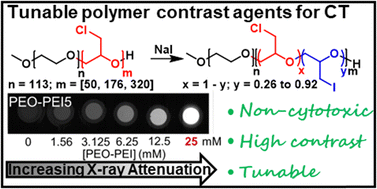
Medical imaging techniques like X-ray, magnetic resonance imaging (MRI), and computed tomography (CT) rely on contrast agents to enhance the visibility of blood vessels, tissues, and organs, making them crucial for medical diagnoses. Contrast agents used clinically for CT are typically small molecules containing iodine, which are associated with nephrotoxicity, often require large doses that can disrupt thyroid function, have short half-lives, and are sometimes immunogenic. Loading/functionalization of larger molecules with iodine may attenuate X-rays similarly to small molecules, but at much lower concentrations, potentially mitigating the adverse effects of current contrast agents. To test this, iodinated poly(ethylene oxide) (PEO) was synthesized with varying amounts of iodine and structural features and examined for use as a contrast agent. First, 5 kg mol−1 PEG containing one terminal hydroxyl was reacted with trimethylaluminum to form a macroinitiator from which block-co-polymers consisting of PEO-co-poly(epichlorohydrin) (PECH) were synthesized with PECH blocks of 5, 15, and 30 kg mol−1. The polymers were subsequently iodinated and characterized with 1H NMR and 13C NMR spectroscopy, size exclusion chromatography (SEC), and differential scanning calorimetry (DSC). X-Ray attenuation was found to be similar to that of iohexol, a conventional contrast agent. Further, we found that high molecular weight polymers were completely non-cytotoxic, unlike iohexol, with polymer size the dominating factor for cytotoxicity rather than iodine concentration. As such, these new materials hold promise as medical contrast agents.
- This article is part of the themed collection: Celebrating International Women’s Day 2026: Women in Journal of Materials Chemistry B
 Please wait while we load your content...


