


 PLATFORM UPDATE:


Tuning enantioselective drug adsorption in isoreticular homochiral metal–peptide frameworks through proximity pore interactions
 a
Ankit K.
Yadav,
a
Andrzej
Gładysiak,
a
Anjali
Verma,
c
Matthew A.
Cranswick,
d
Mas A.
Subramanian,
c
Kyriakos C.
Stylianou
*a
a
Ankit K.
Yadav,
a
Andrzej
Gładysiak,
a
Anjali
Verma,
c
Matthew A.
Cranswick,
d
Mas A.
Subramanian,
c
Kyriakos C.
Stylianou
*a
Abstract
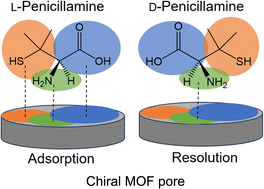
Pharmaceutical research emphasizes stereochemistry and the enantioseparation of racemic drugs because different enantiomers can exhibit varying pharmacological and toxicological properties when interacting with the body's metabolic pathways. Metal–organic frameworks (MOFs) are porous adsorbents that can be designed to possess homochirality within their structures, enabling tunable porosity and enantioselective adsorption of racemic drugs. In our study, we present the synthesis of five novel and homochiral Co-L-GG(R) MOFs (where L-GG = glycyl-L(S)-glutamic acid and R = bipyridyl (bipy) pillar ligands). These isoreticular MOFs were synthesized using the ligand extension strategy. This approach allowed us to systematically control the pore sizes of the MOFs, enabling fine-tuning of the enantioselective adsorption of racemic drugs, primarily DL-penicillamine (Pen). Our findings reveal that the pore size greatly influences enantioselective adsorption, where too large or too small pores hinder the proximity-driven dispersive interactions between the drug and the pore surface, resulting in poor enantioselective adsorption of Pen. We achieved an enantiomeric excess (ee) of 60.1% (L over D), increasing to a maximum 76.1% ee using Co-L-GGvinylbipy by tuning proximity interactions in saturated pores. These results were accomplished by controlling the drug saturation within the MOF pores, promoting favorable interactions.
 Please wait while we load your content...


