


 PLATFORM UPDATE:


Engineering viral vectors with CD200 enhances anti-inflammatory and phagocytosis resistance

Abstract
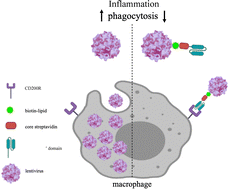
CD200, an immunoregulatory glycoprotein of the immunoglobulin superfamily, suppresses inflammatory signaling by engaging its receptor CD200R, which is predominantly expressed on myeloid cells. To enhance the immune-evading properties of viral vectors, we engineered lentiviral particles displaying the CD200 ectodomain (CD200ED) to exploit anti-inflammatory response and phagocytosis resistance. A fusion gene encoding the mouse CD200 ectodomain and core streptavidin (CD200ED-coreSA) was cloned into the pET-30a(+) plasmid, expressed in E. coli Lemo21(DE3), and purified via immobilized metal affinity chromatography (IMAC). Successful protein assembly was confirmed by SDS-PAGE and western blot. Biotinylated VSV-G pseudotyped lentiviral vectors, encoding a green fluorescent protein reporter, were functionalized with CD200ED-coreSA. When exposed to murine J774A.1 macrophages, CD200ED-modified lentiviruses significantly reduced pro-inflammatory cytokine production - evidenced by 47.1% decrease in TNF-α and 55% decrease in IL-6 - compared to unmodified controls. Additionally, CD200ED anchoring reduced macrophage phagocytosis of lentiviral particles by 25%. These findings demonstrate that CD200-tethering confers dual anti-inflammatory and phagocytosis resistance capabilities to viral vectors, offering a promising strategy to improve gene delivery efficiency in inflammatory environments.
 Please wait while we load your content...


