


 PLATFORM UPDATE:


Molecular versatility of polyproline II helices: from natural proteins to biomimetic materials
 †ab
Sandro
Amador,
†ab
Felipe
Conzuelo,
a
Ana C.
Baptista,
b
Leonor
Morgado
*cd
and
Ana S.
Pina
*a
†ab
Sandro
Amador,
†ab
Felipe
Conzuelo,
a
Ana C.
Baptista,
b
Leonor
Morgado
*cd
and
Ana S.
Pina
*a
Abstract
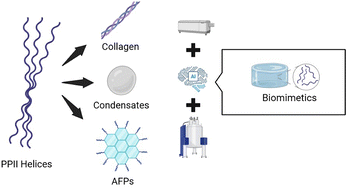
The polyproline II helix is more common as a secondary structure than previously thought. Its significance extends to mediating various protein–protein interactions, both structurally and functionally, in natural systems. This structure is associated with the formation of supramolecular assemblies, which have been investigated for biomimetic applications. In this review, we highlight three examples of polyproline II helix utilization: structurally in collagen and in biomolecular condensates, and as functional motifs in hyperactive antifreeze proteins. The review examines the mechanisms underlying the properties of PPII and consolidates practical design principles for engineering PPII-based assemblies, with an emphasis on sequence composition, residue propensity, and crosslinking strategies that enhance stability and functionality. Additionally, by critically comparing spectroscopic methods (CD, VCD, ROA and NMR) and AI-based prediction tools, we summarize their respective strengths and limitations, providing a practical decision framework for selecting the most suitable characterization techniques for different sample types and research objectives.
- This article is part of the themed collection: Journal of Materials Chemistry B Recent Review Articles
 Please wait while we load your content...


