


 PLATFORM UPDATE:


Multi-step mechanisms of early phospholipid hydrolysis and mineralisation unveiled through combined quantum chemical calculations and experimental analysis
 †*c
and
Nílson
Kunioshi
†*a
†*c
and
Nílson
Kunioshi
†*a
Abstract
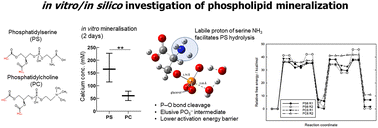
Phospholipids play key roles in bone formation, with phosphatidylserine (PS) reportedly inducing more rapid mineralisation than phosphatidylcholine (PC); however, the underlying mechanisms remains unclear. This study investigated PS and PC mineralisation using experimental methods and computational chemistry. The stationary points in the potential energy surfaces of the reactions were preliminarily found using a neural network potential (PreFerred Potential in Matlantis) capable of predicting the interaction energies for arbitrary combinations of atoms, and then refined through density functional theory calculations (Gaussian16, at the B3LYP/6-31G(d,p) level of theory). When hydrolysis reactions were assumed to be the initial step in the mineralisation of phospholipids, the results were consistent with empirical analysis. PS was found to be more easily hydrolised than PC, primarily owing to the presence of a labile proton in the NH3+ group of serine that facilitates proton transfer, enhancing hydrolysis of PS at lower energy thresholds. Specifically, when a single phospholipid was considered, three distinct hydrolysis routes were identified: between serine (or choline) and phosphate, between glycerol and phosphate, and between an aliphatic carbon chain and the glycerol backbone. In particular, the initial steps of hydrolysis involved the formation of a pentavalent phosphate intermediate. When calculations were performed with two adjacent phospholipid molecules, the loosely bound proton (H+) in the NH3+ group could be readily transferred either to the P–O bond linking serine to the phosphate group; or to the P–O bond connecting the phosphate to glycerol in a neighboring PS6 molecule. These findings reveal the important roles of serine NH3+ in facilitating hydrolysis of PS, and provide insights for designing novel molecules to accelerate bone regeneration.
 Please wait while we load your content...


