


 PLATFORM UPDATE:


Enhanced electrochemical detection of sulfamethoxazole by NaOH-mediated exfoliated boron nitride nanosheets

Abstract
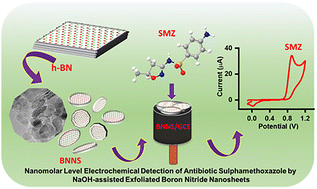
Hexagonal boron nitride nanosheets (BNNSs), produced via a simple NaOH-assisted liquid exfoliation of bulk BN (h-BN), have been employed for the first time for the electrochemical (EC) detection of sulfamethoxazole (SMZ), a widely detected antibiotic in surface and groundwater. The resulting BNNS-modified glassy carbon electrode (BNNS/GCE) exhibited enhanced sensitivity compared to the bare GCE, BNNS(H2O)/GCE, and h-BN/GCE, and a detection limit of 1 nM. The enhanced performance of the BNNS/GCE is attributed to its nanosheet morphology, the NaOH-introduced functional groups, which promoted hydrogen bonding, and Lewis acid–base interactions between the intermediate acid boron (B) with the intermediate basic N-functional groups in SMZ, thus imparting strong affinity and efficient charge transfer with SMZ. The sensor demonstrated selectivity towards SMZ in the presence of potential interferents such as antibiotics, metal ions, and biological molecules. The BNNS/GCE showed repeatability and stability, and exhibited performance in real water samples with reliable recovery rates. This work highlights a cost-effective, environmentally friendly, and scalable EC sensor material for trace-level antibiotic monitoring in complex environmental matrices.
 Please wait while we load your content...


