


A ROS-responsive drug-conjugated heparin biomimetic nanogel for enhancing anticoagulant, antibacterial, and anti-calcification properties of bioprosthetic heart valves

Abstract
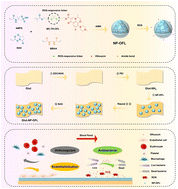
Glutaraldehyde-crosslinked bioprosthetic heart valves (BHVs) widely used in transcatheter or surgical valve replacement have shown the problem of limited lifespan due to their poor endothelialization, insufficient anticoagulant, and anti-calcification properties. Currently, prosthetic valve endocarditis (PVE) has received increasing attention due to its high mortality rate. In view of the serious threat of PVE, the development of novel BHVs with prolonged lifespan and the ability to prevent PVE is in urgent demand. In this work, a heparin biomimetic nanogel conjugated with ofloxacin via a ROS-cleavable linker was introduced to the surface of glutaraldehyde-crosslinked BHVs to develop a new kind of BHV, namely, Glut–NP-OFL. Nanogels with uniform size were efficiently introduced to the surface of BHVs via a simple soaking method. Compared with glutaraldehyde-crosslinked BHVs, the introduction of nanogels significantly reduced cytotoxicity and effectively improved endothelialization performance. Moreover, in vitro, ex vivo and in vivo studies confirmed that the introduction of nanogels obviously improved the anticoagulant, anti-inflammatory, and anti-calcification properties of glutaraldehyde-crosslinked BHVs. Importantly, ofloxacin can be intelligently released in environments with high levels of ROS caused by bacterial invasion, which protects Glut–NP-OFL from damage caused by bacteria. Both in vitro and in vivo experiments confirmed the excellent antibacterial properties of Glut–NP-OFL. Overall, these findings indicate that this multifunctional coating method could be a promising strategy to prolong the lifespan of BHVs.
- This article is part of the themed collection: Journal of Materials Chemistry B HOT Papers
 Please wait while we load your content...


