


 PLATFORM UPDATE:


Radical-trapping-enabled ultra-durable erythritol for high-performance mid-temperature thermal energy storage

Abstract
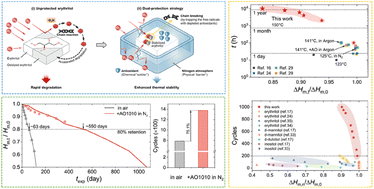
Erythritol, with a high melting enthalpy of ∼340 J g−1, is promising for mid-temperature thermal energy storage, but suffers from poor thermal stability due to oxidative chain reactions on its hydroxyl groups. Here, we tackle this practical challenge by proposing a radical-trapping-based dual-protection strategy that combines nitrogen and an antioxidant. We identify the best antioxidant (AO1010), and show that solely using the antioxidant or nitrogen can only achieve limited improvements, because the unavoidable tiny amount of leaked oxygen molecules from the nitrogen “barrier” can still trigger the chain reactions, and the antioxidant “soldiers” will be constantly depleted upon trapping the intermediate radicals. Using this “barrier + soldier” strategy, we achieve an ultralong lifespan for erythritol with >83% enthalpy retention after heating at 150 °C for 10 000 hours and >90% after 1000 cycles. This strategy enables erythritol-based thermal batteries to have comparable capacity and lifespan to commercial lithium batteries, and can be generalizable to the broad sugar alcohol family and other organic PCMs.
- This article is part of the themed collection: Journal of Materials Chemistry A HOT Papers
 Please wait while we load your content...


