


 PLATFORM UPDATE:

Supramolecular donor–acceptor engineering enables efficient intermolecular charge separation for enhanced photocatalytic hydrogen production

Abstract
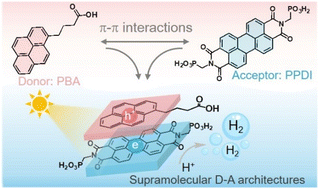
Organic semiconductors are promising candidates for solar-driven hydrogen production due to their structural and functional versatility. However, their photocatalytic performance remains limited by insufficient charge separation arising from the formation of strongly bound electron–hole pairs. To this end, we here report a supramolecular donor–acceptor (D–A) engineering strategy for enhancing charge separation in organic photocatalysts through intermolecular electronic coupling. By co-assembling an electron-deficient perylene diimide derivative and electron-rich 1-pyrenebutanoic acid via π–π interactions, a hetero-stacked D–A architecture with pronounced interfacial dipoles and spatially separated frontier orbitals is constructed, which effectively reduces electron–hole overlap and facilitates intermolecular charge separation. As a result, the optimal sample achieves an exceptional photocatalytic hydrogen production rate of 71.9 mmol g−1 h−1 under visible light irradiation, with a high apparent quantum efficiency of 15.6% at 500 nm, outperforming those of most reported organic systems.
- This article is part of the themed collection: Journal of Materials Chemistry A Emerging Investigators 2026
 Please wait while we load your content...


