


 PLATFORM UPDATE:

Pareto-optimization of sustainable high-entropy alloys: balancing hardness and sustainability via machine learning

Abstract
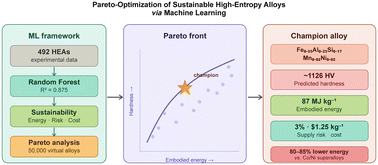
High-Entropy Alloys (HEAs) deliver exceptional mechanical performance but often depend on critical, energy-intensive elements (Co, Mo, Ta, W, Re, Ru, and Hf), creating substantial sustainability challenges. This study bridges the performance–sustainability gap by integrating machine learning with multi-objective Pareto optimization and environmental impact metrics. A Random Forest regressor (R2 ≈ 0.87, MAE = 58.37 HV), trained on 492 experimentally characterized HEAs, was used to predict Vickers hardness while evaluating embodied energy, supply risk, and cost across 50 000 virtual compositions. Pareto analysis identifies a champion Fe0.55Al0.25Si0.17Mn0.02Ni0.02 alloy achieving ∼1126 HV hardness with only 87 MJ kg−1 embodied energy, representing an 80–85% reduction relative to Co- and Ni-based superalloys. This alloy exhibits a hardness-to-energy efficiency of 12.9 HV (MJ kg−1)−1, eight times higher than the Cantor alloy, while minimizing supply risk (3%) and cost ($1.25 kg−1). The top Pareto-optimal candidates reveal a non-equiatomic, iron-centric design dominated by abundant elements (Fe, Si, and Al), departing fundamentally from traditional HEA paradigms. SHapley Additive exPlanations (SHAP) interpretability shows that hardness is governed by aggregate physical descriptors rather than individual elemental identities. The proposed alloy achieves superalloy-level hardness with a steel-like environmental footprint, demonstrating compatibility between sustainability and performance.
 Please wait while we load your content...


