


 PLATFORM UPDATE:

Disentangling the role of Al, Co, and Mn dopants in LiNiO2 cathodes via synchrotron-based probes
 *a
Zehao
Cui,
b
Molleigh B.
Preefer,
a
Kevin
Stone,
a
Arumugam
Manthiram
b
and
Johanna
Nelson Weker
*a
*a
Zehao
Cui,
b
Molleigh B.
Preefer,
a
Kevin
Stone,
a
Arumugam
Manthiram
b
and
Johanna
Nelson Weker
*a
Abstract
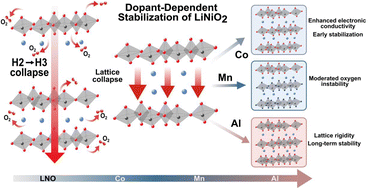
High-nickel layered oxide cathodes like LiNiO2 (LNO) offer high energy density but suffer from rapid structural degradation during cycling, limiting their practical application. This study systematically investigates the dopant-dependent structural evolution of LNO through controlled substitution (5%) with Co, Mn, and Al. Identical synthesis and electrochemical conditions are employed across all compositions to isolate intrinsic dopant-specific effects rather than to maximize the absolute capacity. Using a suite of synchrotron-based characterization techniques: X-ray absorption spectroscopy, operando and ex situ X-ray diffraction, and transmission X-ray microscopy with X-ray absorption near-edge structure, the structural evolution is tracked across multiple length scales and cycling stages to reveal the hidden bulk and interfacial transformations occurring in the cathode. Co enhances the electronic conductivity and delays cation mixing upon electrochemical cycling. Mn provides intermediate structural stabilization and improves capacity retention, Al doping most effectively suppresses the unstable H2–H3 phase transition and mitigates oxygen loss, offering the greatest long-term stability. Among the doped variants studied, LiNi0.95Al0.05O2 demonstrates the highest capacity retention, minimal particle cracking, and the most reversible Ni redox behavior. These findings disentangle dopant-specific stabilization pathways in Ni-rich layered oxides and establish mechanistic design principles for improving structural integrity and cycle life in high-Ni cathodes.
 Please wait while we load your content...


