


 PLATFORM UPDATE:


Probing Ag filamentary networks in a neuromorphic device using surface-enhanced Raman scattering
 a
and
Giridhar U.
Kulkarni
*a
a
and
Giridhar U.
Kulkarni
*a
Abstract
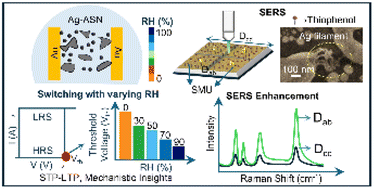
For progress in artificial intelligence (AI), the way ahead involves the design of neuromorphic devices that combine low energy consumption with cost-effectiveness and sustainability. Among emerging neuromorphic systems, silver (Ag)-based devices offer distinct advantages due to their high electrical conductivity and facile redox activity, enabling efficient signal transmission and rapid switching via Ag filament formation. However, their practical integration is often limited by device variability influenced by environmental factors such as humidity and oxygen. Addressing this, we report a chemically prepared, self-formed dewetted Ag device-termed the “Ag-Artificial Synaptic Network (Ag-ASN)” and investigate its neuromorphic behavior under varying relative humidity (RH) and O2 atmospheres. This provides insights into encapsulating such devices in controlled environments for optimal performance. Electrical measurements under different conditions reveal variations in device response, corroborated by spectroscopic and diffraction analyses. Notably, Surface-Enhanced Raman Scattering (SERS) is employed in an unconventional way to probe electric field-induced morphological changes in the Ag-ASN. Although microscopy, spectroscopy, and simulation have been used to study metallic filament formation in Ag-based neuromorphic devices, SERS has not been applied previously for probing the morphological changes and is demonstrated here for the first time. Using thiophenol as a molecular probe, SERS enhancement increased eight-fold under N2 and two-fold at 55% RH after electrical activation, consistent with microscopic observations. The effect of oscillating electric fields on the thiophenol orientation is further examined in situ using the Ag-ASN platform, highlighting SERS as a powerful diagnostic tool for unveiling filament dynamics in metallic neuromorphic systems.
- This article is part of the themed collection: Honorary collection in celebration of Prof. D. D. Sarma’s contributions to materials science
 Please wait while we load your content...


