


 PLATFORM UPDATE:


Novel Ruddlesden–Popper double anti-perovskites Mg4AA′C: first-principles screening and device simulation study for high-efficiency photovoltaic absorbers

Abstract
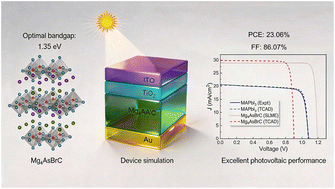
Developing high-efficiency and environmentally friendly photovoltaic absorbers is crucial for next-generation solar energy technologies. In this work, we propose a novel design strategy that integrates the structural advantages of Ruddlesden–Popper (RP) layered perovskites with the anion-splitting concept in anti-perovskites, enabling the incorporation of the favorable features of both anti-perovskite and double perovskite systems within a unified framework. Based on this strategy, a series of RP-type layered double anti-perovskites, Mg4AA′C (A = As, Sb, Bi; A′ = Cl, Br, I), were designed and systematically investigated and the resulting compounds exhibit excellent stability and optoelectronic performance. HSE06 hybrid functional calculations with spin–orbit coupling (SOC) indicate that all compounds are direct-bandgap semiconductors. Notably, Mg4AsBrC exhibits a direct bandgap of 1.35 eV, close to the Shockley–Queisser optimal limit (∼1.34 eV). Carrier mobilities were computed using the Feynman polaron model considering optical phonon scattering. Except for Mg4SbIC and Mg4BiIC, all compounds show high electron mobilities (98.69–4205.07 cm2 V−1 s−1) and long carrier scattering times (49.20–1195.51 fs), significantly exceeding MAPbI3 (∼24 cm2 V−1 s−1, ∼10 fs). Their visible-light absorption coefficients reach 105 cm−1, comparable to those of MAPbI3. Power conversion efficiencies (PCEs) estimated via the spectroscopic limited maximum efficiency (SLME) method exceed that of MAPbI3 (∼30%). Sentaurus TCAD simulations predict a device-level PCE of up to 23.06% with a fill factor of 86.07%, surpassing those of MAPbI3 (∼17.99%, 79.31%). These results demonstrate that Mg4AA′C, particularly Mg4AsBrC, exhibit outstanding optoelectronic properties and strong potential as high-efficiency photovoltaic absorbers.
 Please wait while we load your content...


