


 PLATFORM UPDATE:

Fe doping-regulated electron transfer and Co d-band center: boosting ORR/OER catalysis of Co@NCNTs for stable zinc–air batteries
 a
Li
Zhang,
*ab
a
Li
Zhang,
*ab
Abstract
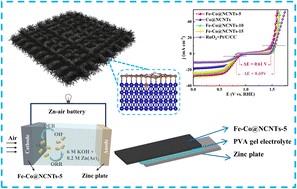
Improving the performance and durability of transition metal and nitrogen-doped carbon (TM/N–C) composite catalysts is crucial for the efficient operation of zinc–air batteries (ZABs). In this work, a catalyst of Fe-doped Co nanoparticles and N-doped carbon nanotubes (denoted as Fe–Co@NCNTs-5) grown on carbon cloth (CC) was developed. Co3O4 particles derived from the cobalt formate framework (Co-FF) were uniformly anchored on the CC surface, and the resulting assembly served as a high-quality precursor for subsequent high-temperature calcination with dicyandiamide and ferrocene at a specific ratio to obtain an integrated self-supporting electrode material. The Fe–Co@NCNTs-5 catalyst exhibited considerable advantages in the bifunctional catalysis of the oxygen reduction reaction (ORR) and the oxygen evolution reaction (OER). In an alkaline medium, the half-wave potential (E1/2) for the ORR reached 0.87 V (vs. RHE), while the overpotential for the OER at a current density of 10 mA cm−2 was only 250 mV (vs. RHE). Density functional theory (DFT) calculations demonstrated that Fe doping enhances electron transfer at the catalyst–carrier interface, optimizes the d-band center of Co, and lowers the energy barrier of catalytic reactions, thereby substantially improving its ORR and OER catalytic performance. Liquid and flexible ZABs assembled with this catalyst achieved peak power densities of 180.0 mW cm−2 and 96.9 mW cm−2, respectively. Both types of batteries showed superior rate performance and cycling stability compared to those assembled with commercial Pt/C and RuO2. This study provides a novel strategy for the synthesis of composite bifunctional carbon materials for ZABs.
 Please wait while we load your content...


