


 PLATFORM UPDATE:

MFU-4 as a benchmark molecular sieve for efficient CO2/CH4 separation in biogas upgrading

Abstract
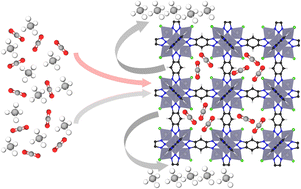
The efficient separation of CO2 from CH4 is central to industrial biogas upgrading for the production of pipeline-quality biomethane. Kinetic, molecular sieve-based adsorption is preferred over thermodynamic approaches, making small-pore adsorbents such as CMS-3K and ion-exchanged ETS-4 the current industrial standard. Here, we show, through a combination of breakthrough experiments and computational analysis, that the ultra-microporous Zn triazolate MOF MFU-4 significantly surpasses these benchmarks. Its unique architecture, featuring alternating small and large cages connected by narrow, square-shaped pore gates, kinetically hinders CH4 diffusion while facilitating rapid CO2 transport and achieving high CO2 uptake, effectively overcoming the long-standing trade-off between CO2/CH4 selectivity and CO2 capacity. As a result, MFU-4 achieves CO2/CH4 kinetic selectivity up to twice that of ETS-4 and four times that of CMS-3K, with CO2 working capacities up to seven and four times higher, respectively, over the 100–500 kPa range, and an exceptional CO2 uptake of ∼7.4 mol kg−1 at 298 K and 500 kPa. These findings establish MFU-4 as an excellent molecular sieve for biogas upgrading, delivering performance far beyond current industrial standards.
- This article is part of the themed collection: Journal of Materials Chemistry A HOT Papers
 Please wait while we load your content...


