


 PLATFORM UPDATE:


Grotthuss-type proton transport governed by oxygen coordination environment in VO2 polymorphs

Abstract
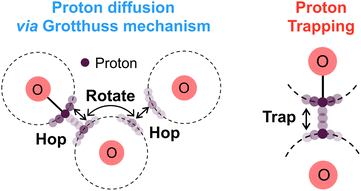
Proton-insertion coupled electron transfer (PICET) offers fast-charge energy storage; however, predictive links between oxide crystal structures and proton mobility remain limited. Here, we establish a dynamics-based structure–transport framework by comparing three stoichiometrically identical VO2 polymorphs—VO2(A), VO2(B), and rutile VO2(R)—using molecular dynamics driven by a fine-tuned Universal Model for Atoms (UMA) machine-learned interatomic potential. We show that proton mobility is governed by a hierarchy of structural descriptors: (i) the availability of low-coordination oxygen sites that stabilize proton binding, (ii) the connectivity of reorientation–hopping motifs that enable pathway percolation, and (iii) oxygen–oxygen separation that controls hydrogen-bond-assisted transfer barriers. VO2(A) supports a percolating one-dimensional rotation–direct-hop pathway with single-file-like signatures and the lowest activation energy (≈20.7 kJ mol−1), whereas VO2(B) exhibits anisotropic transport that requires intermittent edge hopping and a higher activation energy (≈39.6 kJ mol−1). The lack of favorable sites and connected motifs in VO2(R) leads to localized proton distributions and strongly suppressed diffusion. These results translate polymorph-dependent PICET behavior into transferable design rules for engineering oxides capable of fast and reversible proton intercalation.
 Please wait while we load your content...


