


 PLATFORM UPDATE:


A degradation-free platform for intrinsic comparison of metal nanoparticles in methane-fueled SOFC anodes

Abstract
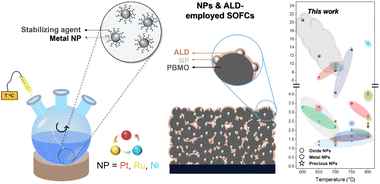
Solid oxide fuel cells (SOFCs) offer a compelling route for direct utilization of various fuels such as CH4. Although perovskite-based ceramic anodes mitigate carbon coking issues encountered in conventional Ni-YSZ electrodes, their sluggish electrochemical kinetics necessitate the incorporation of metal nanocatalysts. However, nanoparticle sintering, carbon-induced degradation, and uncontrolled dispersion obscure intrinsic catalytic effects, making rational catalyst selection largely empirical. Here, we present a degradation-free evaluation platform based on a porous Pr0.5Ba0.5MnO3−δ (PBMO) anode, integrating colloidal synthesis of monodisperse Pt, Ru, and Ni nanoparticles with an ultrathin Al2O3 overlayer deposited by atomic layer deposition (ALD). The PBMO scaffold provides a hydrocarbon-compatible perovskite framework, while uniform particle size and spatial distribution enable fair comparison across catalyst types. The conformal Al2O3 coating stabilizes the nanoparticles without altering their catalytic nature. Under wet CH4 at 700 °C, Pt delivered the most pronounced enhancement, achieving a 3-fold reduction in area-specific resistance without performance degradation, followed by Ru and Ni. This result provides direct evidence of intrinsic catalytic behavior that becomes apparent only under stabilized conditions. Collectively, these findings establish a robust methodology for intrinsic, size- and degradation-independent assessment of nanocatalysts, and further provides a framework that can guide the rational design of high-performance SOFC electrodes.
 Please wait while we load your content...


