


 PLATFORM UPDATE:

Gas-phase growth of two-dimensional nonlayered metallic Cu2Se nanoflakes for ultrasensitive surface-enhanced Raman scattering
 *a
*a
Abstract
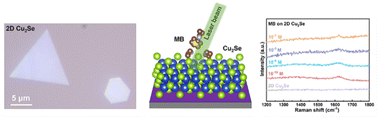
Developing non-noble-metal-based surface-enhanced Raman scattering (SERS) materials with high sensitivity, stability, and reproducibility remains a critical challenge for molecular sensing. In this work, we report the molecular sieve-assisted chemical vapor deposition growth of two-dimensional nonlayered Cu2Se nanoflakes with metallic electronic characteristics and investigate their performance as chemically enhanced SERS substrates. The Cu2Se nanoflakes enable ultrasensitive detection of methylene blue (MB) and crystal violet (CV) with limits of detection reaching 10−10 M and ultrahigh enhancement factor of 4.6 × 10⁸. Systematic spectroscopic tests, transport studies, and theoretical calculations indicate that the Raman enhancement is dominated by an interfacial charge-transfer mechanism rather than electromagnetic effects. The nonlayered crystal structure provides abundant surface dangling bonds that strengthen molecular adsorption and promote efficient charge transfer between the substrate and adsorbed molecules. Consequently, the SERS response exhibits a pronounced surface-dominated behavior with clear thickness dependence. These results establish two-dimensional nonlayered metallic Cu2Se as an effective chemically enhanced SERS platform.
 Please wait while we load your content...


