


 PLATFORM UPDATE:


Trade-off between O2 activation and active-site regeneration on biaxially strained Co-doped MoS2 monolayers: a density functional theory study
 *ab
*ab
Abstract
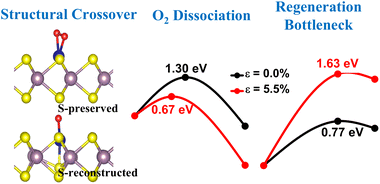
Strain engineering can tune O2 adsorption, activation, and dissociation on two-dimensional transition-metal dichalcogenide catalysts; however, its synergistic impact on O2 activation/dissociation and active-site regeneration, both of which are required for sustained turnover, remains unclear. Herein, spin-polarized density functional theory is used to examine O2 activation and regeneration at a substitutional Co site in monolayer MoS2 (Co@VS). Phonon calculation results obtained for VS and Co@VS monolayers show the absence of imaginary modes at a 10% biaxial tensile strain (the highest strain examined), confirming dynamical stability at the upper bound of the studied strain window. With increasing strain, the O2-adsorbed Co@VS site undergoes a crossover between the S-preserved and S-reconstructed configurations near 4.5%, promoting the activation process. Consequently, O2 dissociation preferentially follows a Mo-assisted pathway, yielding a deeply stabilized Co–O–Mo termination. The regeneration process assessed using an atomistic oxygen-migration proxy is increasingly hindered by strain: between 4.5% and 5.0%, oxygen penetrates the lattice deeply and disrupts the site, whereas at a strain of 5.5%, oxygen removal is rate-limited by a large lateral diffusion barrier of 1.63 eV, consistent with the strengthened Co–O interactions. Overall, the applied strain facilitates O2 dissociation, but it can also deepen oxide-like product wells and kinetically impede oxygen removal along the lattice-site hopping pathway. More broadly, the obtained results highlight an activation–regeneration trade-off that may be overlooked when strain engineering is primarily evaluated by activation descriptors, suggesting that optimal strain windows for strain-tuned single-atom catalysts should balance dissociation facilitation against the site recovery feasibility.
 Please wait while we load your content...


