


 PLATFORM UPDATE:


Emergence of GeSe-based thermoelectric materials empowered by structural modulations and metavalent bonding
 *a
*a
Abstract
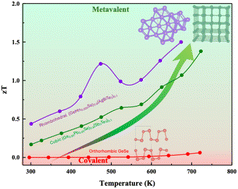
The IV–VI semiconductor GeSe has recently attracted significant attention in thermoelectric research due to its structural similarity to SnSe-based thermoelectric materials. However, despite favorable theoretical predictions, the experimental realization of high thermoelectric performance remains elusive in the pristine orthorhombic phase of GeSe using conventional doping methods. Subsequently, various alloying strategies (e.g., alloying with I–V–VI2 compounds such as AgBiSe2, AgBiTe2, etc.) have been developed to transform the ambient orthorhombic phase into higher symmetry rhombohedral and cubic phases. These structural transitions are also accompanied by changes in chemical bonding. The resulting property portfolio – including moderate electrical conductivity, large optical dielectric constant, high Born effective charge, high Grüneisen parameter with strong lattice anharmonicity, and unique bond-breaking behavior in the rhombohedral and cubic phases of GeSe – can be attributed to a recently proposed novel bonding mechanism called metavalent bonding. The metavalent rhombohedral and cubic phases of GeSe exhibit highly improved thermoelectric performance compared to the pristine orthorhombic phase. In this review article, we analyze the role of metavalent bonding in improving the thermoelectric performance of GeSe, along with providing a concise overview of the concept of metavalent bonding, the associated quantum mechanical material map, and evidence in support of metavalent bonding in the rhombohedral and cubic phases of GeSe. We also discuss the successful alloying strategies that stabilize the rhombohedral and cubic phases at room temperature and present the thermoelectric properties of these phases, together with an analysis of the underlying factors contributing to enhanced carrier concentration, high Seebeck coefficient, and low lattice thermal conductivity observed in these metavalent phases. Finally, the current challenges and potential applications of this strategy for enhancing the thermoelectric performance of other material systems are discussed.
- This article is part of the themed collections: Journal of Materials Chemistry A Recent Review Articles and Thermoelectric energy conversion
 Please wait while we load your content...


