


 PLATFORM UPDATE:

Rigid and electrode-compatible multicomponent organic crystals for piezoelectric energy harvesting
 †a
Maria
Zubair,
†a
Pierre-André
Cazade,
b
Tara E.
Ryan,
a
Krishna
Hari
a
and
Sarah
Guerin
*ad
†a
Maria
Zubair,
†a
Pierre-André
Cazade,
b
Tara E.
Ryan,
a
Krishna
Hari
a
and
Sarah
Guerin
*ad
Abstract
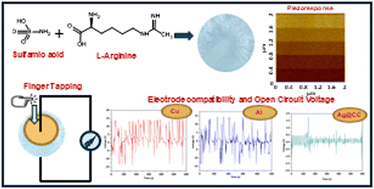
Organic piezoelectric materials are entering a new era of discovery and design, where properties can be engineered at the nanoscale using crystal engineering principles. As well as single-component piezoelectric molecular crystals, materials scientists can use multicomponent materials such as cocrystals and metal–organic frameworks to develop tailored, sustainable sensing and actuating materials. Here, we present a multicomponent crystal (MCC), L-argininium amidosulfonate hemihydrate (Sa·L-Arg·0.5H2O), which exhibits a maximum local longitudinal piezoelectric response of d33 = 3.53 pC N−1, matching the ideal predicted longitudinal piezoelectric response of d22 = 3.11 pC N−1, and predicted shear piezoelectric response of d36 = 4.47 pC N−1. Sa·L-Arg·0.5H2O is scaled up, and self-assembled into stand-alone polycrystalline discs. The polycrystalline discs were successfully electroded with diverse methods, including Cu tapes, Al tapes, and Ag nanoparticles deposited on Carbon cloth (Ag@CC). The open-circuit voltage of the electroded disc of Sa·L-Arg·0.5H2O revealed a maximum voltage of 14.5 V for the Cu, and 14.2 V for the Al electrodes, respectively, when subjected to manual tapping, simulating a common mechanical action. Sa·L-Arg·0.5H2O represents the first multicomponent piezoelectric crystal disc in our research that simultaneously demonstrates high voltage output, low surface roughness, and high mechanical strength without a corresponding increase in brittleness.
 Please wait while we load your content...


