


 PLATFORM UPDATE:


Dual-salt-enabled atomic engineering of Zn–N4 sites through Na/Cl modulation for high-performance bifunctional oxygen electrocatalysis

Abstract
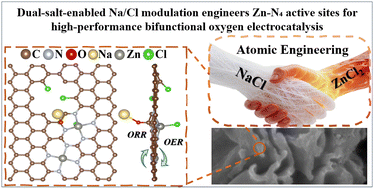
Metal-nitrogen-carbon (MNC) catalysts based on conventional transition metals (Fe/Co/Mn) offer high activity but often suffer from limited durability. Here, dual metal chlorides were introduced separately during electrospinning and pyrolysis to provide precursors for MN4 (M = Zn/Cu/Sn/Al) active sites together with alkali-metal (A = Li/Na/K) and Cl-regulation groups, enabling atomic-level engineering of M,A-codoped carbon fibers (M-A-CFs). In particular, NaCl-assisted electrospinning coupled with ZnCl2-mediated pyrolysis promotes the formation of Zn–Cl coordination and Cl-derived functionalities, resulting in a modified local coordination environment around Zn–N4 sites. The Zn/Na/Cl codoped nanofibers prepared at 900 °C (ZnNa-CFs-900) exhibit outstanding oxygen electrocatalysis and long-term stability in rechargeable zinc-air batteries. The presence of NaCl-derived species and strengthened Zn–N/Cl mixed coordination is closely correlated with changes in the local electronic characteristics of Zn–N4 sites and enhanced oxygen reaction kinetics, leading to improved bifunctional catalytic performance. Systematic evaluation of M-A-CFs shows that all M-Na catalysts display significant oxygen reduction activity, with Zn–Na being the most effective pairing. Further screening confirms that Cl regulation is essential for enabling Zn–Na synergy and achieving high bifunctional oxygen catalytic performance. Overall, this dual-salt-assisted electrospinning and pyrolysis strategy provides a general design principle for developing next-generation MNC catalysts beyond traditional transition-metal systems.
 Please wait while we load your content...


