


 PLATFORM UPDATE:


From low- to high-entropy layered transition metal oxide cathodes: recent progress on spray-drying technologies in materials design for sodium-ion batteries
 ab
Angélica María
Baena-Moncada,
c
Carla
Real,
d
Irlan S.
Lima,
b
Karen
Magno da Silva,
ef
Hudson
Zanin,
d
Walter
Estrada,
*a
Lucio
Angnes
*b
and
Josué M.
Gonçalves
*ef
ab
Angélica María
Baena-Moncada,
c
Carla
Real,
d
Irlan S.
Lima,
b
Karen
Magno da Silva,
ef
Hudson
Zanin,
d
Walter
Estrada,
*a
Lucio
Angnes
*b
and
Josué M.
Gonçalves
*ef
Abstract
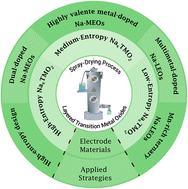
Sodium-ion batteries (SIBs) have emerged as a cost-effective and sustainable alternative to lithium-ion-based energy technologies, intensifying the search for high-performance cathode materials. Among the available candidates, layered transition-metal oxides with the general formula NaxTMO2 stand out due to their high energy density and structural versatility. Recently, entropy engineering, ranging from low-to high-entropy oxide designs (LEOs, MEOs, and HEOs), has been reported as an effective strategy to enhance structural stability, ionic transport, and electrochemical performance. In parallel, spray-drying has gained increasing attention as a scalable, industrially relevant synthesis route that ensures homogeneous cation distribution, controlled particle morphology, and reproducible microstructures. This review provides a critical and systematic assessment of spray-drying technologies applied to the synthesis of layered NaxTMO2 cathodes for SIBs, with particular emphasis on entropy-driven material design. Fundamental aspects of the spray-drying process, including atomization methods, are discussed in detail. In addition, statistical information was obtained based on the type of precursor used in the spray-drying synthesis of NaxTMO2 and the post-thermal processing treatments applied. Recent advances in spray-dried LEOs, MEOs, and HEOs are analyzed, correlating composition trends and strategies with structural features and electrochemical performance. Moreover, common misclassifications of entropy levels in the literature are addressed through a rigorous discussion of configurational entropy criteria. Finally, current challenges and future perspectives for spray-drying-assisted entropy engineering of layered cathodes are outlined, highlighting its potential for large-scale manufacturing of next-generation SIBs.
- This article is part of the themed collection: Journal of Materials Chemistry A Recent Review Articles
 Please wait while we load your content...


