


 PLATFORM UPDATE:


Biomass-derived potassium-doped reduced graphene oxide-like material for high-performance supercapacitors: experimental and computational analysis

Abstract
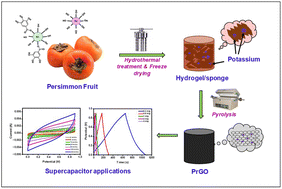
With the growing energy demand and limited resources, the development of cost-effective and efficient materials is essential. Among these, carbon-based nanomaterials offer promising characteristics for energy applications. Bio-based carbon nanomaterials are particularly promising for energy storage devices like supercapacitors due to their sustainability and performance characteristics. This study presents a cost-effective method for synthesizing a bio-based reduced graphene oxide (rGO)-like material using persimmon fruit, a readily available resource in East Asia. A clean two-step thermal process was employed to synthesize an rGO-like material, eliminating the need for toxic chemicals commonly used in conventional approaches. The material is derived from persimmon and naturally doped with potassium, which contributes to enhanced supercapacitor performance. A systematic optimization of carbonization temperature (600–1000 °C) and heating rate (5–15 °C min−1) was carried out using residual yield analysis, Raman spectroscopy, XRD, and TGA, identifying 800 °C and 10 °C min−1 as the optimal synthesis conditions. Density Functional Theory (DFT) calculations were performed to elucidate the electronic structure and validate the improved electrochemical properties observed experimentally. The electrochemical performance of the synthesized material was investigated in acidic, basic, and neutral electrolytes, using a three-electrode setup. The maximum Cs achieved was 302 F g−1 at a scan rate of 2 mV s−1 in an acidic electrolyte. Furthermore, a symmetric supercapacitor device fabricated using the synthesized material demonstrated a specific capacitance of 98 F g−1, an energy density of 11 Wh kg−1, and a power density of 89.8 W kg−1 at a current density of 0.2 A g−1. Remarkably, the device maintained its original capacitance even after 5000 charge–discharge cycles. These results highlight the potential of potassium-doped, biomass-derived rGO-like materials as effective electrode materials for supercapacitor applications.
- This article is part of the themed collection: Foundations to frontiers in materials chemistry: 75 years of IIT Kharagpur
 Please wait while we load your content...


