


 PLATFORM UPDATE:


Enhanced interfacial charge separation via MnIn2S4/Zn2TiO4 heterojunction for light-induced fuel production

Abstract
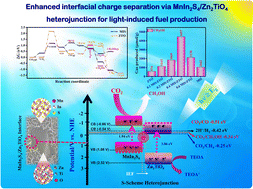
Sustainable development necessitates photocatalytic CO2 reduction for generating value-added carbon products. However, synthesizing photocatalysts with superior carrier-separation capabilities via straightforward methods for the photoreduction of CO2 remains a significant challenge. In this study, we present a unique interfacial-heterostructured photocatalyst synthesized through the in situ growth of MnIn2S4 (MIS) nanosheets on Zn2TiO4 (ZTO) nanorods constructed from several zinc glycolates via a sol–gel process. The active sites of MIS facilitated the conversion of CO2 into formate and promoted the desorption of CO* from its surface, producing value-added carbon products as confirmed by both in situ experimental characterization and theoretical calculations. Compared with the other samples, the optimal photocatalyst (0.4-MIS/ZTO) exhibited exceptional activity for CO2 photoreduction under ultraviolet-visible light irradiation, with CO, CH4, and CH3OH gas yields of 484, 345, and 4457 µmol g−1 within 7 h, respectively. The exceptional photocatalytic activity of 0.4-MIS/ZTO can be attributed to the effective modification of the surface and S-scheme interface of the heterostructure, promoting charge-pair generation, separation, and transfer. This study presents a simple and efficient strategy for constructing high-performance 2D/1D heterostructures to convert CO2 into high-value carbon products through photocatalytic reduction.
 Please wait while we load your content...


