


 PLATFORM UPDATE:


Development of a multifunctional aminated Zr/Ce bimetallic MOF-assisted membrane for suppressing radical-induced deterioration in hydrogen fuel cells

Abstract
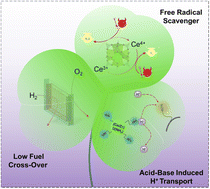
The persistent oxidative degradation and poor performance under low humidity conditions remain major challenges to the advancement of proton exchange membrane fuel cells. In this work, we address these issues by combining the radical scavenging ability of cerium (Ce) with the thermal and chemical stability of zirconium (Zr) based metal organic frameworks (MOFs). An amine functionalized Zr–Ce bimetallic MOF, [(Zr/Ce)U(NH2)] was synthesized and incorporated into a sulfonated poly(ether ether ketone) (sPEEK) membrane to develop a stable composite proton exchange membrane. This design overcomes key limitations of conventional Ce-based additives including leaching, agglomeration, thermal instability, and low proton conductivity at reduced relative humidity. The optimized membrane SPBM-3 with 3 wt% filler delivered a peak power density of 681.5 mW cm−2 at 80 °C and 100% RH which is a 78.4% improvement over pristine sPEEK. At 60% RH it retained a high performance of 524.7 mW cm−2 with only 23% decay, while sPEEK showed 43% degradation. The nanoporous MOF reduced fuel crossover by 37.3% and improved membrane selectivity and efficiency. Durability testing showed only 11.34% decay in open circuit voltage over 100 h with a degradation rate of 1.1 mV h−1 at 30% RH while the pristine membrane failed within 50 h. The integration of Zr–Ce bimetallic MOF fillers with immobilized radical quenching sites and acid–base interactions enabled a strong synergy that enhanced both performance and durability. Thus, this work not only addresses key limitations of Ce-based additives but also opens a new avenue for rationally engineered MOF-integrated membranes.
 Please wait while we load your content...


