


A stability-directed dual-filter strategy for MOF electrolytes to achieve durable high-power PEM water electrolysis under dynamic operation
 *b
*b
Abstract
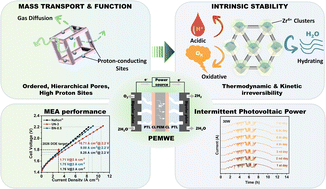
The high current-density performance of proton exchange membrane water electrolyzers (PEMWEs) is critically limited by mass transport constraints in the anode catalyst layer, where inefficient proton conduction and sluggish gas-bubble removal coexist. Functional metal–organic frameworks (MOFs) offer a promising pathway to address these limitations, but a fundamental gap persists: what structural characteristics guarantee both high performance and long-term durability under the harsh, oxidative conditions of the PEMWE anode? To answer this, we strategically introduce two structurally distinct MOFs into the anode catalyst layer in this demanding environment: IM-UiO-66-AS (featuring robust Zr6-oxo clusters and hierarchical porosity) and BUT-8(Cr) (possessing a high density of sulfonic acid groups). Both materials enhance the performance and stability of the anode compared to the bare Nafion® baseline. The optimized electrode, incorporating IM-UiO-66-AS, achieves a current density of 10.71 A cm−2 at 2.2 V (a 30% improvement) and shows a voltage decay rate three times lower than that of the bare Nafion® baseline over 500 hours. Although BUT-8(Cr) also outperforms the baseline, this material degrades more rapidly than IM-UiO-66-AS, and the latter maintains robust stability even under dynamic cycling simulating intermittent renewable energy. Beyond reporting two effective functional electrolyte materials, this comparative study leverages a full suite of electrochemical and physicochemical diagnostics to establish, for the first time, a clear set of material survival criteria for MOFs in PEMWE anode. These criteria are formulated as a practical dual-filter selection framework: (1) a function filter, requiring hierarchical porosity coupled with proton-conducting sites, and (2) an indispensable stability filter, demanding the rigid clusters of hard Lewis acidic metals (e.g., Zr4+) to ensure irreversible stability under acidic, oxidative, and hydrating conditions. Thus, this work moves beyond isolated material demonstrations, offering a generalizable design roadmap for developing durable, high-power PEMWEs compatible with intermittent renewable energy.
 Please wait while we load your content...


